What Is SLM Metal Printing in Dentistry?
| SLM metal printing is a manufacturing process that builds metal frameworks layer by layer using a laser. More precisely, selective laser melting is a metal additive manufacturing process that produces three-dimensional components from a fine metal powder, guided by a digital design file and a high-powered laser.
In dentistry, it is used to produce cobalt chrome partial denture frameworks, crown and bridge substructures and implant components with accurate fit that is difficult to achieve reliably through conventional casting. |
Key Points |
|
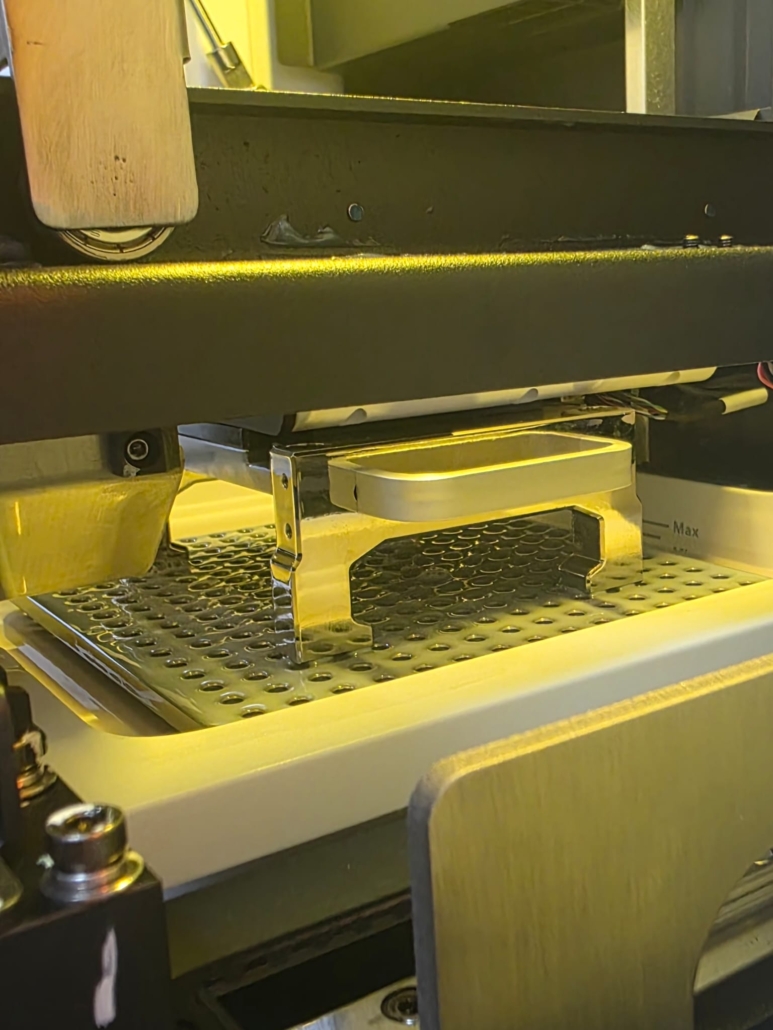
How the Process WorksA digital design file is sliced into thin cross-sectional layers. A fine layer of cobalt chrome powder is spread across the build platform and a laser fuses the powder in the pattern of the first layer. The platform lowers by one layer thickness, new powder is spread and the process repeats until the full component is built. The part is then removed, support structures are taken off and the component is finished by hand. |
SLM vs castingTraditional casting requires a physical wax pattern, investment material, a burnout cycle and molten metal injection. Each stage introduces potential dimensional error: investment shrinkage, gas entrapment porosity and alloy shrinkage during solidification. SLM bypasses all of these stages. The digital file defines the geometry and the laser builds it precisely, producing a fully dense part with no porosity. |
SLM vs polymer 3D printingSLM is distinguished from polymer printing processes such as FDM by the use of metal powder and a high-power laser. Unlike selective laser sintering (SLS), SLM fully melts the powder rather than fusing it at particle boundaries, producing a denser, stronger component. |
Applications in DentistrySLM is used principally in dental manufacturing to produce cobalt chrome removable partial denture frameworks. It is also used for crown and bridge metal substructures, implant bars and bars for overdentures, orthodontic appliances and custom implant abutments when titanium SLM powder is used. |
Cobalt chrome framework productionSLM-printed cobalt chrome frameworks offer several practical advantages over cast equivalents. Complex designs with thin connectors, multiple rests and precision attachments are produced with the same accuracy as simpler cases. The same framework can be reprinted from the original digital file if a replacement is needed, without a new impression. Learn more about our chrome cobalt frameworks. |
Clinical AdvantagesFor the prescribing dentist, SLM-printed frameworks arrive ready to fit with consistent accuracy across cases. A framework that seats correctly first time, with clasps that engage the survey line without adjustment, saves chair time and simplifies the fitting appointment. |
SLM Metal Printing at SimcastSimcast produces SLM-printed cobalt chrome RPD frameworks, crown and bridge substructures and orthodontic metal work from digital files as a standard service. Submit a case via the Send Files page. See our SLM direct metal printing service page for more details. |
Frequently Asked Questions |
|
Find out about SLM printing at Simcast |

